Marco Rubio: U.S. Expects Rwandan Troops to Begin Withdrawing from DRC by Mid-July
Washington Says Progress Is Being Made, But M23 Remains a Major Challenge
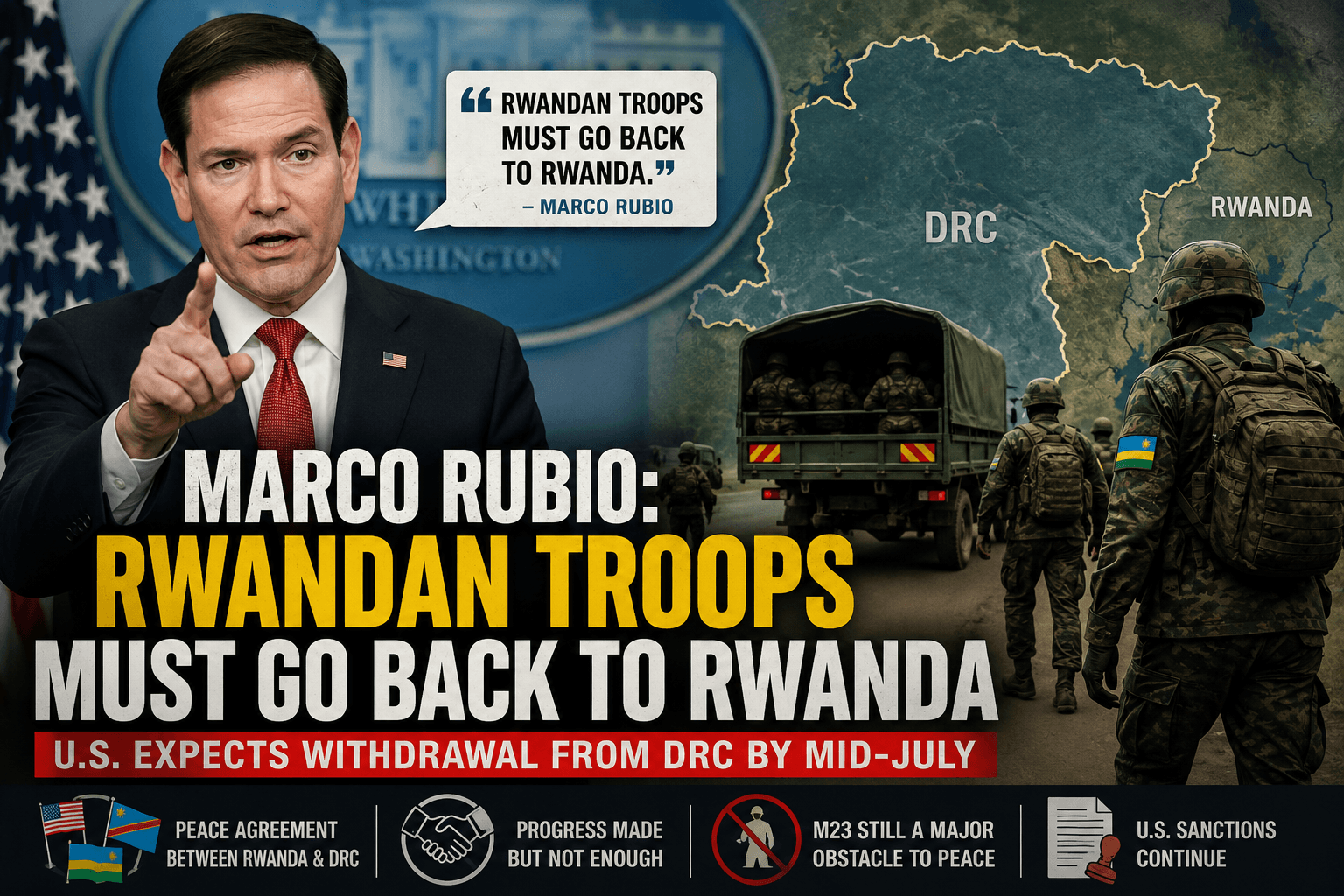
U.S. Secretary of State Marco Rubio has said that the United States expects Rwandan troops to begin withdrawing from eastern Democratic Republic of the Congo (DRC) by mid-July, as part of efforts to implement the peace agreement signed between Rwanda and the DRC.
Speaking before the U.S. House Foreign Affairs Committee, Rubio acknowledged that some progress had been made but warned that key aspects of the agreement were still not being fully respected.
“As for the DRC and Rwanda, they signed a peace agreement. Unfortunately, it is not being well respected. We had to impose some sanctions,” Rubio told lawmakers. “On the Rwandan side, we are starting to observe a certain respect for the agreement. Things are moving forward—not fast enough, certainly, but we hope that the withdrawal of Rwandan troops from the region will take effect by mid-next month. Of course, the M23 issue remains to be resolved.”
New U.S. Sanctions
Rubio’s remarks came shortly after the U.S. Treasury Department announced new sanctions against John Imani Nzenze, identified as M23’s intelligence chief, and Gustave Kubwayo, a senior commander of the Democratic Forces for the Liberation of Rwanda (FDLR).
Washington accuses both men of leading armed groups involved in destabilizing eastern Congo.
The sanctions form part of a broader U.S. strategy aimed at enforcing the Washington Peace Accords signed between Rwanda and the DRC in December 2025.
More Pressure on Key Actors
In recent months, the United States has expanded sanctions against several individuals linked to the conflict.
In April, former Congolese President Joseph Kabila was sanctioned over allegations that he provided financial and political support to M23 and its political ally, the AFC coalition.
The U.S. also maintains sanctions against AFC leader Corneille Nangaa and M23 military commander Sultani Makenga, accusing them of directing military operations against the Congolese government.
Earlier this year, Washington further increased pressure by sanctioning senior officers of the Rwanda Defence Force (RDF), alleging that they provided military, logistical, and financial support to M23 operations in eastern Congo.
M23 Still a Major Obstacle
Despite signs of progress in the peace process, Rubio stressed that the M23 issue remains unresolved.
The armed group continues to control large parts of North and South Kivu provinces, including the strategic cities of Goma and Bukavu.
The conflict has displaced millions of civilians, disrupted trade routes, and contributed to one of the world’s most severe humanitarian crises.
A Diplomatic Victory for Kinshasa?
Analysts say that if Rwandan troops begin withdrawing from eastern Congo, it would represent a significant diplomatic achievement for the Congolese government.
However, they caution that lasting peace will depend not only on troop withdrawals but also on whether M23 relinquishes control of occupied territories and whether all armed groups operating in the region are effectively neutralized.
While Washington believes progress is being made, Rubio’s comments highlight the considerable challenges that remain before a durable peace can be achieved in eastern Congo.
— Article prepared by Nation Radio TV.